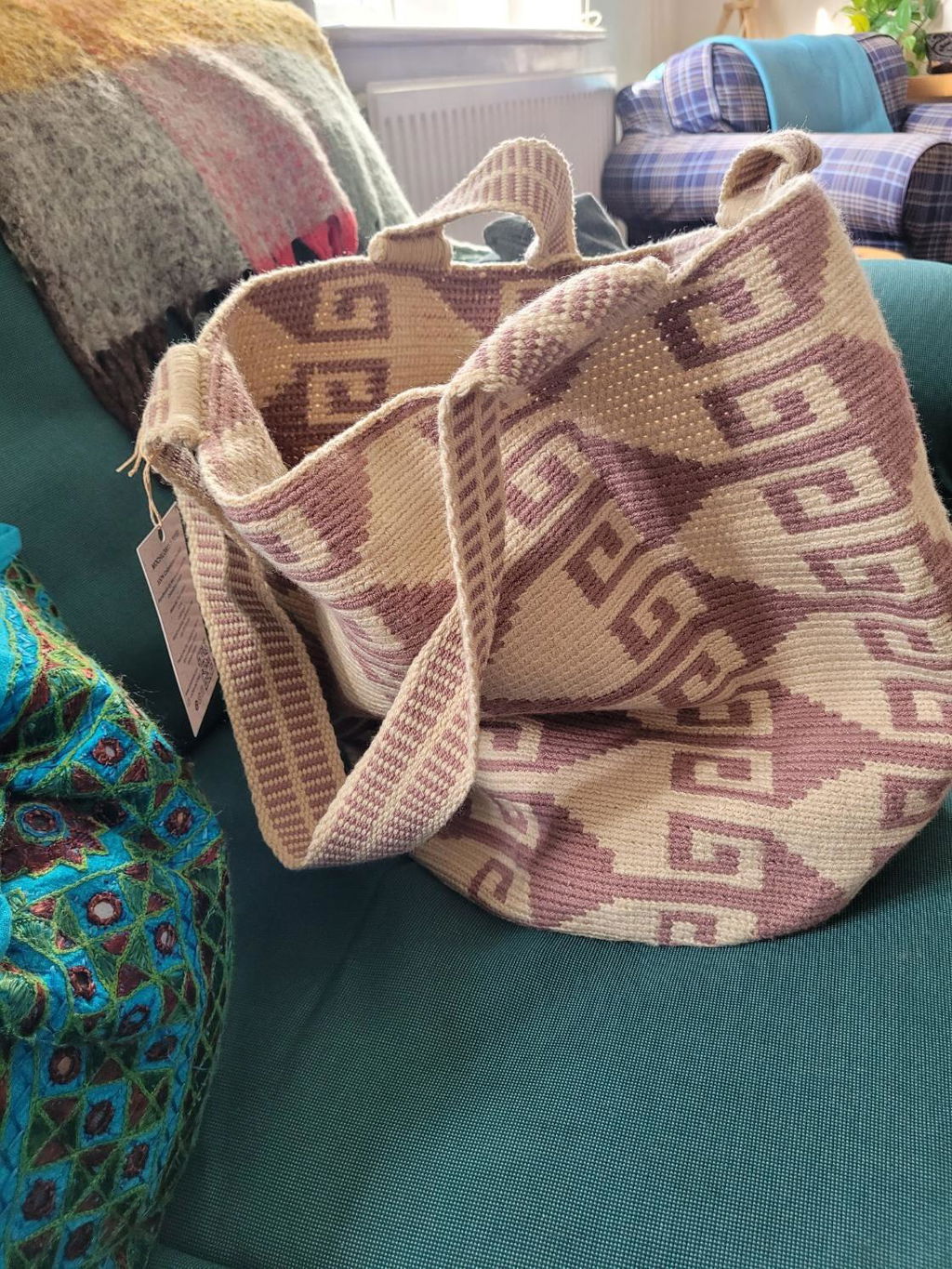
A beautiful, handmade bag shouldn't sit in your closet waiting for a special occasion. At AMPMsis, we believe artisan-made accessories belong in your daily rotation—from your morning coffee run and city strolls to weekend getaways, long-haul flights, and casual dinners.
Our handwoven Wayuu bags and Colombian-made accessories are rooted in centuries of Indigenous tradition, yet designed to integrate seamlessly into modern wardrobes. If you’ve ever admired a vibrant, handwoven mochila and wondered, “Where would I actually wear this?”—the answer is simple: almost anywhere.
Pair a classic crossbody mochila with straight-leg denim and a clean white tee for effortless everyday style, or use a spacious handwoven tote as an elevated travel carry-on. Ground bold patterns against neutral tones like cream, camel, and navy, letting the handcrafted texture act as the centerpiece of your outfit.
Colombia is a country that lives in color.
Colombia’s handmade pieces are more than accessories. They carry color, memory, technique and the creative spirit of the communities that make them.
You see it in the vibrant streets of its cities, in tropical fruits overflowing from market stalls, in flowers blooming across its landscapes, in music, celebrations, clothing and, perhaps most beautifully, in the work of its artisans. Here, color is more than decoration. It is a language. It speaks of joy, identity, memory and belonging.
A country where color tells a story
From the deep blues of the Caribbean Sea to the intense greens of the mountains, the golden tones of the coast and the extraordinary variety of flowers and fruits, Colombia offers an endless palette of inspiration.
But the country's color is not found only in its landscapes. It is also found in its people.
Colombian culture is expressive and full of contrasts. Its music, dance, food, architecture and traditional crafts reflect a country shaped by many regions, communities and traditions.
And throughout Colombia, artisans have transformed that cultural richness into objects that can be touched, worn and passed from one generation to another.
When color becomes craftsmanship
In artisan communities, choosing a color is not simply an aesthetic decision. Threads are combined patiently. Patterns emerge slowly. Techniques learned over generations meet the individual creativity of the person making the piece.
That is why handmade Colombian crafts feel so different from something produced thousands of times by a machine. There is a human hand behind them. There is time behind them. There is knowledge behind them. And there is always a story.
A woven bag can carry unexpected combinations of pink, turquoise, black, sand, blue or green. Another may be created entirely in natural tones. Both can express Colombia in completely different ways. Because Colombian joy does not have just one color.
Every region has its own voice
One of the most fascinating things about Colombian craftsmanship is its diversity. Different regions have developed their own materials, techniques, symbols and visual languages over generations.
The weaving traditions associated with Wayuu communities in La Guajira, for example, are instantly recognizable for their extraordinary use of color and geometric patterns. Other Colombian artisan traditions explore natural fibers, embroidery, ceramics, jewelry, wood and countless other forms of making. These objects are beautiful, but their value goes far beyond beauty. They represent knowledge.
Skills are learned, practiced and preserved. Techniques can travel from one generation to the next, while every artisan still leaves something personal in the piece they create.
Made by hands, not machines
Perhaps this is why we are so drawn to handmade objects today. In a world where almost everything can be reproduced instantly, an artisan piece asks us to look differently. Look closer and you may see slight variations in the weave. A line that is not perfectly identical to the next.
A combination of colors that may never be repeated in the same way. Those differences are not imperfections. They are the signature of the human hands that made it. And that is something worth preserving.
Carry a little piece of Colombia
Choosing handmade also means choosing a slower, more meaningful way of consuming: one that values time, origin and the people behind every piece.
At AMPMsis, we believe Colombian craftsmanship deserves to travel beyond borders, becoming part of everyday life rather than remaining a souvenir kept on a shelf.
A bag can travel through Bogotá, New York, Miami, Madrid or Paris and still carry the essence of the place where it began. Its colors can start conversations. Its patterns can spark curiosity. And behind every thread remains the knowledge and creativity of the artisan who made it.
That is the Colombia we want to share with the world: joyful, creative, diverse, unexpected and deeply connected to its roots.
Because when you carry a handmade Colombian piece, you are carrying more than color.
You are carrying culture.You are carrying craftsmanship.You are carrying a story.
Explore the AMPMsis collection and carry a handmade piece of Colombia wherever your journey takes you.
🌎 Worldwide delivery🤎 Every purchase supports Colombian artisans and helps preserve their craft.
AMPMsis — From Their Hands to Your Journey.
The Artisans of Detail: The Role of Men in Wayuu Weaving
While the vibrant patterns of a Wayuu mochila are world-renowned, there is a hidden strength behind every bag that often goes unspoken. Beyond the crochet lies the "gasa"—the intricate, heavy-duty strap that serves as the backbone of every piece. Discover the story of the Wayuu men who master the traditional loom, preserving a legacy of family collaboration and ancestral precision that takes our accessories from Bogotá to your everyday journey.
The Wayuu woman is the central figure of one of Colombia's most representative indigenous cultures. In the territory of La Guajira, her role extends far beyond caring for the home: she is the bearer of lineage, ancestral memory, and the spiritual continuity of her people.
In Wayuu culture, life is organized around the feminine. Identity, heritage, and clan membership are transmitted through the mother, making women the true heart of the community.
A matrilineal society led by women
Wayuu culture is governed by a matrilineal system, where women determine family lineage. From grandmothers to girls, each generation receives and transmits knowledge that keeps the collective identity alive.
Wayuu women educate, guide, and train new generations, ensuring that customs, stories, and values are not lost over time. Their word is authority, and their experience, guidance.
Rites, customs and training of the Wayuu woman
During adolescence, Wayuu girls undergo a traditional process of preparation for adulthood. This learning period strengthens their connection to culture, discipline, patience, and respect for the community.
During this period, essential knowledge is transmitted: from household management to the art of weaving, understood not only as a craft, but as a symbolic language and cultural expression.
The fabric: identity, wisdom and sustenance
Wayuu weaving is one of the most recognized expressions of this culture, and it is the women who master this ancestral knowledge. Each design, color, and shape has its own meaning, inspired by nature, dreams, and the stories of the Wayuu people.
Weaving is an act of memory and resistance. Through their hands, Wayuu women transform thread into visual narratives that speak of their environment, their history, and their worldview. Furthermore, weaving represents a source of livelihood that allows many families to maintain their economic independence without relinquishing their identity.
The silent force that sustains the community
The strength of Wayuu women is not imposed; it is built day by day. They nurture, lead, mediate, and protect social equilibrium. In contexts marked by extreme weather conditions and historical challenges, their resilience has been key to the community's survival.
Their strength is collective, deeply linked to the well-being of the clan and to respect for the land and the ancestors.
Honoring Wayuu women is honoring living culture
Recognizing the value of Wayuu women is recognizing a culture that remains alive thanks to their knowledge, their work, and their worldview. Each handcrafted piece created by their hands is a testament to a history that refuses to disappear.
At AMPM SIS , we believe in the value of handcrafted items, the importance of preserving ancestral knowledge, and a deep respect for the communities that keep tradition alive. Each creation, inspired by artisanal work, seeks to honor the feminine strength that creates, sustains, and transmits identity.
Because behind every fabric there is a woman,And behind every Wayuu woman, a culture that resists and flourishes.
How was AMPMsis created and who does it support?
AMPMsis is the result of the passion for art and culture of communities of women artisans. It is a project born from respect, admiration, and commitment to these women who dedicate their lives to preserving their traditions. AMPMsis not only financially supports these artisans but also provides them with national and international visibility and recognition.
More than just crafts: Mochilones Wayuu, Arhuaco Mochilones, and crochet creations
In every stitch of a Mochilone, in every weave of an Arhuaco mochione and in every crocheted product, there is much more than artisanal beauty: there are stories, traditions, and a cultural power that transcends time.
The Wayuu Mochilon: The art of the desert
The Wayuu mochilone is one of the most recognizable symbols of Colombia and the world. It originates in the heart of La Guajira, where Wayuu women transform thread into a language of colors and geometric shapes that tell the dreams, stories, and symbols of their culture.
Each Wayuu bag can take weeks to make. It's a unique creation, impossible to replicate, because behind each design lies the weaver's personal story. By wearing one, you're not just adding an accessory to your style: you're becoming a bearer of the memory of a people who have withstood the desert wind and sun with creativity and resilience.
The Arhuaca Mochilone: ancestral wisdom of the Sierra Nevada
In contrast to the vibrant Wayuu colors, the Arhuaco mochilon is characterized by its simplicity and spiritual depth. Made exclusively by women who have already given birth, this weave represents maturity, wisdom, and connection with Mother Earth.
Their designs, in natural tones, are not mere ornaments: they are symbols of the Arhuaco worldview, stories about nature, balance, and life. Each Arhuaco mochilon is a bridge between generations, a knowledge passed down from mothers to daughters that keeps the identity of an entire community alive.
Crochet products: creativity that transforms yarn into art
Beyond mochilones, crochet becomes a tool for creating all kinds of vibrant pieces: bags, accessories, clothing, and decor. What makes crochet special is that, like mochilones, each product is created with patience and dedication, transforming a simple thread into beauty and utility.
Crochet is also a form of innovation within tradition. It allows artisans to reinterpret their cultural heritage and adapt it to new trends, offering pieces that combine modernity and roots, fashion and memory.
Choosing a craft is choosing with your heart
When you buy a Wayuu mochilon, an Arhuaco mochilones, or a crochet product, you're not just buying an accessory. You're supporting artisan women who preserve their culture and support their families with their craft. You're carrying with you centuries of tradition, resilience, and love for the land.
Each piece is unique, unrepeatable, and full of meaning. And most importantly, it allows you to be part of a story that connects past, present, and future.
✨ Because more than craftsmanship, these creations are living stories woven with patience and love. By choosing them, you choose tradition, culture, and a piece of history to carry with you.
A beautiful, handmade bag shouldn't sit in your closet waiting for a special occasion. At AMPMsis, we believe artisan-made accessories belong in your daily rotation—from your morning coffee run and city strolls to weekend getaways, long-haul flights, and casual dinners.
Our handwoven Wayuu bags and Colombian-made accessories are rooted in centuries of Indigenous tradition, yet designed to integrate seamlessly into modern wardrobes. If you’ve ever admired a vibrant, handwoven mochila and wondered, “Where would I actually wear this?”—the answer is simple: almost anywhere.
Pair a classic crossbody mochila with straight-leg denim and a clean white tee for effortless everyday style, or use a spacious handwoven tote as an elevated travel carry-on. Ground bold patterns against neutral tones like cream, camel, and navy, letting the handcrafted texture act as the centerpiece of your outfit.
Colombia is a country that lives in color.
Colombia’s handmade pieces are more than accessories. They carry color, memory, technique and the creative spirit of the communities that make them.
You see it in the vibrant streets of its cities, in tropical fruits overflowing from market stalls, in flowers blooming across its landscapes, in music, celebrations, clothing and, perhaps most beautifully, in the work of its artisans. Here, color is more than decoration. It is a language. It speaks of joy, identity, memory and belonging.
A country where color tells a story
From the deep blues of the Caribbean Sea to the intense greens of the mountains, the golden tones of the coast and the extraordinary variety of flowers and fruits, Colombia offers an endless palette of inspiration.
But the country's color is not found only in its landscapes. It is also found in its people.
Colombian culture is expressive and full of contrasts. Its music, dance, food, architecture and traditional crafts reflect a country shaped by many regions, communities and traditions.
And throughout Colombia, artisans have transformed that cultural richness into objects that can be touched, worn and passed from one generation to another.
When color becomes craftsmanship
In artisan communities, choosing a color is not simply an aesthetic decision. Threads are combined patiently. Patterns emerge slowly. Techniques learned over generations meet the individual creativity of the person making the piece.
That is why handmade Colombian crafts feel so different from something produced thousands of times by a machine. There is a human hand behind them. There is time behind them. There is knowledge behind them. And there is always a story.
A woven bag can carry unexpected combinations of pink, turquoise, black, sand, blue or green. Another may be created entirely in natural tones. Both can express Colombia in completely different ways. Because Colombian joy does not have just one color.
Every region has its own voice
One of the most fascinating things about Colombian craftsmanship is its diversity. Different regions have developed their own materials, techniques, symbols and visual languages over generations.
The weaving traditions associated with Wayuu communities in La Guajira, for example, are instantly recognizable for their extraordinary use of color and geometric patterns. Other Colombian artisan traditions explore natural fibers, embroidery, ceramics, jewelry, wood and countless other forms of making. These objects are beautiful, but their value goes far beyond beauty. They represent knowledge.
Skills are learned, practiced and preserved. Techniques can travel from one generation to the next, while every artisan still leaves something personal in the piece they create.
Made by hands, not machines
Perhaps this is why we are so drawn to handmade objects today. In a world where almost everything can be reproduced instantly, an artisan piece asks us to look differently. Look closer and you may see slight variations in the weave. A line that is not perfectly identical to the next.
A combination of colors that may never be repeated in the same way. Those differences are not imperfections. They are the signature of the human hands that made it. And that is something worth preserving.
Carry a little piece of Colombia
Choosing handmade also means choosing a slower, more meaningful way of consuming: one that values time, origin and the people behind every piece.
At AMPMsis, we believe Colombian craftsmanship deserves to travel beyond borders, becoming part of everyday life rather than remaining a souvenir kept on a shelf.
A bag can travel through Bogotá, New York, Miami, Madrid or Paris and still carry the essence of the place where it began. Its colors can start conversations. Its patterns can spark curiosity. And behind every thread remains the knowledge and creativity of the artisan who made it.
That is the Colombia we want to share with the world: joyful, creative, diverse, unexpected and deeply connected to its roots.
Because when you carry a handmade Colombian piece, you are carrying more than color.
You are carrying culture.You are carrying craftsmanship.You are carrying a story.
Explore the AMPMsis collection and carry a handmade piece of Colombia wherever your journey takes you.
🌎 Worldwide delivery🤎 Every purchase supports Colombian artisans and helps preserve their craft.
AMPMsis — From Their Hands to Your Journey.
The Artisans of Detail: The Role of Men in Wayuu Weaving
While the vibrant patterns of a Wayuu mochila are world-renowned, there is a hidden strength behind every bag that often goes unspoken. Beyond the crochet lies the "gasa"—the intricate, heavy-duty strap that serves as the backbone of every piece. Discover the story of the Wayuu men who master the traditional loom, preserving a legacy of family collaboration and ancestral precision that takes our accessories from Bogotá to your everyday journey.
The Wayuu woman is the central figure of one of Colombia's most representative indigenous cultures. In the territory of La Guajira, her role extends far beyond caring for the home: she is the bearer of lineage, ancestral memory, and the spiritual continuity of her people.
In Wayuu culture, life is organized around the feminine. Identity, heritage, and clan membership are transmitted through the mother, making women the true heart of the community.
A matrilineal society led by women
Wayuu culture is governed by a matrilineal system, where women determine family lineage. From grandmothers to girls, each generation receives and transmits knowledge that keeps the collective identity alive.
Wayuu women educate, guide, and train new generations, ensuring that customs, stories, and values are not lost over time. Their word is authority, and their experience, guidance.
Rites, customs and training of the Wayuu woman
During adolescence, Wayuu girls undergo a traditional process of preparation for adulthood. This learning period strengthens their connection to culture, discipline, patience, and respect for the community.
During this period, essential knowledge is transmitted: from household management to the art of weaving, understood not only as a craft, but as a symbolic language and cultural expression.
The fabric: identity, wisdom and sustenance
Wayuu weaving is one of the most recognized expressions of this culture, and it is the women who master this ancestral knowledge. Each design, color, and shape has its own meaning, inspired by nature, dreams, and the stories of the Wayuu people.
Weaving is an act of memory and resistance. Through their hands, Wayuu women transform thread into visual narratives that speak of their environment, their history, and their worldview. Furthermore, weaving represents a source of livelihood that allows many families to maintain their economic independence without relinquishing their identity.
The silent force that sustains the community
The strength of Wayuu women is not imposed; it is built day by day. They nurture, lead, mediate, and protect social equilibrium. In contexts marked by extreme weather conditions and historical challenges, their resilience has been key to the community's survival.
Their strength is collective, deeply linked to the well-being of the clan and to respect for the land and the ancestors.
Honoring Wayuu women is honoring living culture
Recognizing the value of Wayuu women is recognizing a culture that remains alive thanks to their knowledge, their work, and their worldview. Each handcrafted piece created by their hands is a testament to a history that refuses to disappear.
At AMPM SIS , we believe in the value of handcrafted items, the importance of preserving ancestral knowledge, and a deep respect for the communities that keep tradition alive. Each creation, inspired by artisanal work, seeks to honor the feminine strength that creates, sustains, and transmits identity.
Because behind every fabric there is a woman,And behind every Wayuu woman, a culture that resists and flourishes.
How was AMPMsis created and who does it support?
AMPMsis is the result of the passion for art and culture of communities of women artisans. It is a project born from respect, admiration, and commitment to these women who dedicate their lives to preserving their traditions. AMPMsis not only financially supports these artisans but also provides them with national and international visibility and recognition.
More than just crafts: Mochilones Wayuu, Arhuaco Mochilones, and crochet creations
In every stitch of a Mochilone, in every weave of an Arhuaco mochione and in every crocheted product, there is much more than artisanal beauty: there are stories, traditions, and a cultural power that transcends time.
The Wayuu Mochilon: The art of the desert
The Wayuu mochilone is one of the most recognizable symbols of Colombia and the world. It originates in the heart of La Guajira, where Wayuu women transform thread into a language of colors and geometric shapes that tell the dreams, stories, and symbols of their culture.
Each Wayuu bag can take weeks to make. It's a unique creation, impossible to replicate, because behind each design lies the weaver's personal story. By wearing one, you're not just adding an accessory to your style: you're becoming a bearer of the memory of a people who have withstood the desert wind and sun with creativity and resilience.
The Arhuaca Mochilone: ancestral wisdom of the Sierra Nevada
In contrast to the vibrant Wayuu colors, the Arhuaco mochilon is characterized by its simplicity and spiritual depth. Made exclusively by women who have already given birth, this weave represents maturity, wisdom, and connection with Mother Earth.
Their designs, in natural tones, are not mere ornaments: they are symbols of the Arhuaco worldview, stories about nature, balance, and life. Each Arhuaco mochilon is a bridge between generations, a knowledge passed down from mothers to daughters that keeps the identity of an entire community alive.
Crochet products: creativity that transforms yarn into art
Beyond mochilones, crochet becomes a tool for creating all kinds of vibrant pieces: bags, accessories, clothing, and decor. What makes crochet special is that, like mochilones, each product is created with patience and dedication, transforming a simple thread into beauty and utility.
Crochet is also a form of innovation within tradition. It allows artisans to reinterpret their cultural heritage and adapt it to new trends, offering pieces that combine modernity and roots, fashion and memory.
Choosing a craft is choosing with your heart
When you buy a Wayuu mochilon, an Arhuaco mochilones, or a crochet product, you're not just buying an accessory. You're supporting artisan women who preserve their culture and support their families with their craft. You're carrying with you centuries of tradition, resilience, and love for the land.
Each piece is unique, unrepeatable, and full of meaning. And most importantly, it allows you to be part of a story that connects past, present, and future.
✨ Because more than craftsmanship, these creations are living stories woven with patience and love. By choosing them, you choose tradition, culture, and a piece of history to carry with you.
At AMPMsis, we transform Wayuu tradition and the art of crochet into unique pieces that carry the essence of Colombia with you.
QUESTIONS? WE’VE GOT YOU.
Are AMPMSIS bags handmade?
Yes. Our Wayuu bags are handwoven in Colombia by skilled artisans using traditional techniques. Because each piece is handmade, small variations make every bag unique.
Where are your bags made?
Our handwoven bags are made in Colombia in collaboration with artisan communities, including Wayuu artisans in La Guajira.
How long does shipping take?
Shipping times vary by destination. Orders are shipped from Huntsville, Alabama, and tracking information is provided once your order is on its way.
What is your return policy?
We offer 30-day returns on eligible items. Please review our return policy for full conditions and details.
Will my bag look exactly like the photos?
Each AMPMSIS piece is handmade, so slight variations in weaving, pattern placement, and finishing may occur. These subtle differences are part of what makes each piece one of a kind.
Beautiful woven purse strap. Even prettier than shown in the photos. Shipped fast too.
Thank you so much for the 5-star review! We are thrilled that you love your new woven strap and that it exceeded your expectations in person. Thank you for your support, and enjoy your new look!
Thank you so much for the 5-star review! We're so glad the colors match what you were expecting and that you love the handwoven quality. Our artisan partners put so much care into making these straps, and it means the world to know it shows!
absolutely fabulous gift to myself. I'm so impressed with the fast delivery , packaging and presentation. I live in Wales UK and delivery was really fast. The bag is beautifully made, bigger than i expected - which is great, i can put my sketchbooks and my picnic in it for my days out. I cant say enough good things about this lovely bag. thankyou
Thank you so much for this beautiful review! We are absolutely thrilled to hear this, especially since you are officially our milestone first overseas sale. We love knowing the bag is the perfect size for your sketchbooks and picnics. Thank you again for your trust, enjoy your days out, and thank you for supporting our small business!